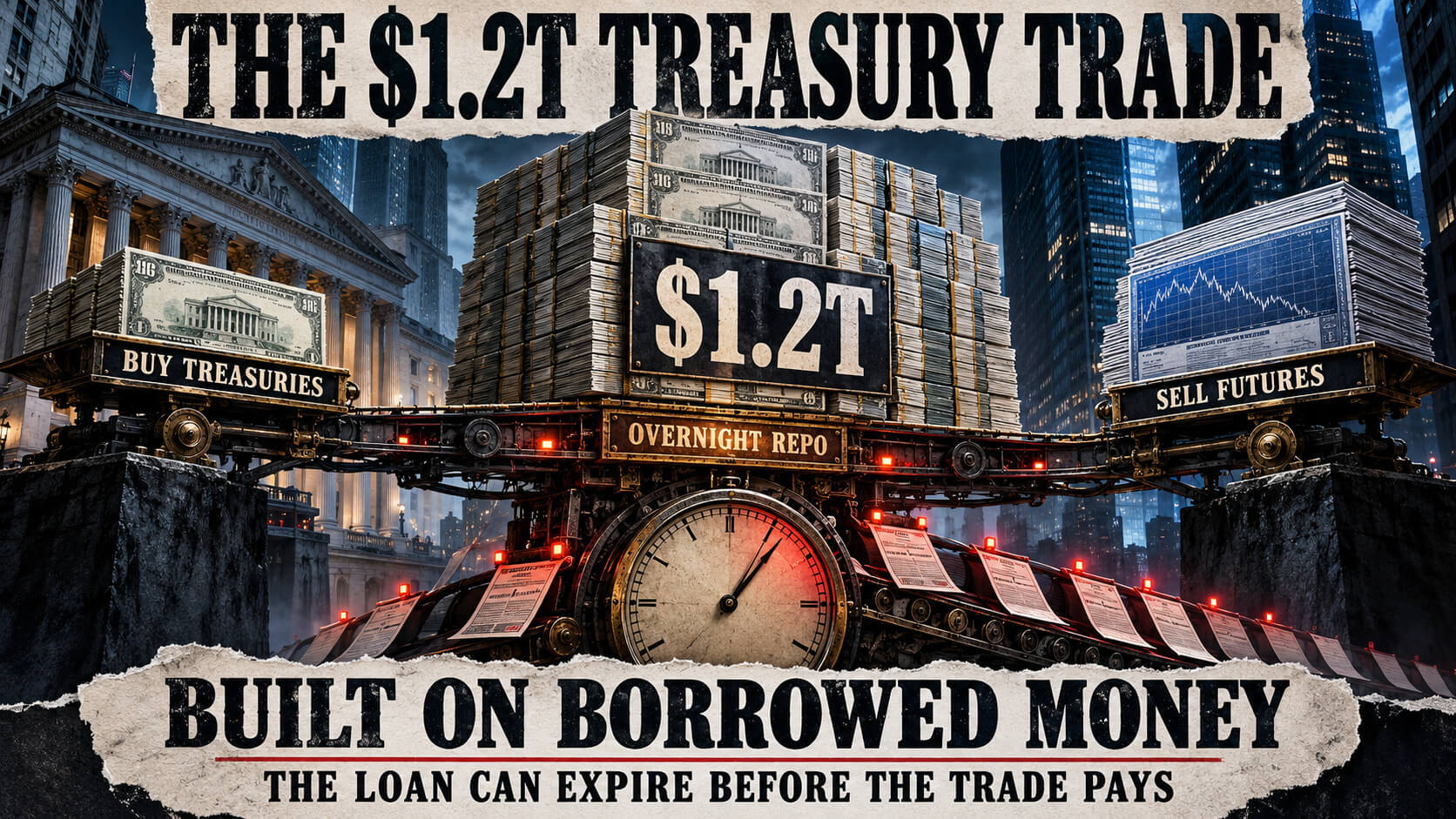
Hedge funds built a $1.2 trillion Treasury trade on money they have to keep borrowing
Story summary
Companies can own a mountain of US government debt without betting that bond prices will rise. Hedge funds buy Treasury securities and sell futures against them to collect a small pricing gap, borrowing most of the purchase money to make the return worthwhile. The government gets another buyer, whos
📌 Key Highlights & Takeaways
- Companies can own a mountain of US government debt without betting that bond prices will rise.
- Hedge funds buy Treasury securities and sell futures against them to collect a small pricing gap, borrowing most of the purchase money to make the return worthwhile.
- The government gets another buyer, whos
Companies can own a mountain of US government debt without betting that bond prices will rise. Hedge funds buy Treasury securities and sell futures against them to collect a small pricing gap, borrowing most of the purchase money to make the return worthwhile.
The government gets another buyer, whose interest lasts as long as the trade pays.
The catch is that the loan can expire tomorrow while the trade needs longer to pay off. The government's ability to repay its debt doesn't solve the fund's need to repay its lender.
This is the Treasury cash-futures basis trade, and the sums involved are large enough to reach well beyond the bond desk. Morgan Stanley estimated positions had fallen 20% this year to about $1.2 trillion, according to Sept. 24 reports.
The bank hadn't found evidence of broad basis-related market stress at that point, so a smaller trade wasn't automatically a trade that would blow up.
You can buy a Treasury security outright, or trade a futures contract that sets terms now for a transaction completed later. The contract specifies which securities can be delivered against it, linking their prices without making them identical.
When futures are expensive enough relative to an eligible bond, the fund buys the bond and sells the futures. Investors wanting bond-market exposure through contracts supply the other side, leaving the fund to hold the actual securities.
Selling the futures is the hedge: if bond prices fall, that short position can earn money that offsets much of the loss on the bond. The fund aims to collect the pricing gap as the contract approaches delivery, while limiting its exposure to the market's overall direction.
From an on-chain analytics and liquidity distribution perspective, developments around "Hedge funds built a $1.2 trillion Treasury trade on money they have to keep borrowing" signal important shifts in network participation. Market participants observe that derivative funding metrics, exchange reserve telemetry, and smart contract protocol interactions reflect cautious accumulation alongside disciplined risk hedging across the sector.
Technical research analysts at 1UpTrade Live note that high-density order book clusters and volume-weighted average price (VWAP) benchmarks near recent consolidation floors will serve as pivotal indicators. Market observers are advised to cross-examine telemetry on verified block explorers before making capital allocations.
Editorial Fact-Check & Verification Note: This briefing was curated, corroborated, and synthesized by the 1UpTrade Live Editorial Desk. Readers following "Hedge funds built a $1.2 trillion Treasury trade on money they have to keep borrowing" are encouraged to review the full primary source coverage linked below for complete historical context, direct quotes, and official statements.
Crypto Profit & Yield Calculator
Simulate trading returns, staking APY, and crypto gains with real-time fee modeling.
Source: CryptoSlate.
Read the full story at the original source ↗
For questions: mrsmithcons@gmail.com.
❓ Frequently Asked Questions (Day Trading Hacks Briefing)
What on-chain catalyst or market signal triggered this Day Trading Hacks movement?
Institutional on-chain telemetry, cold storage accumulation, and derivative funding rates indicate spot liquidity positioning that underpins this Day Trading Hacks development.
How should investors interpret current liquidity pools and network hash activity?
Derivative funding remains balanced and exchange reserves continue trending downward, mitigating systemic liquidation cascades and strengthening the underlying structural floor.
Where are the critical technical support and invalidation levels?
Anchored volume-weighted average price (VWAP) benchmarks and high-density order book clusters near prior consolidation ranges serve as key risk management thresholds.
📈 Live Scalping Metrics & Prop Firm Risk Model
Institutional order flow data, risk-reward ratios, and prop challenge models.
⚡ Access Trading Terminal ➔More from 1UpTrade Live


 🤖 1UpTrade Quant
Fibonacci Structure Engine [WillyAlgoTrader] – Indikator von WillyAlgoTrader
Von Tradingview.com gemeldete aktuelle Berichterstattung: Fibonacci Structure Engine [WillyAlgoTrader] – Indik...
 🐋 CryptoAce VIP
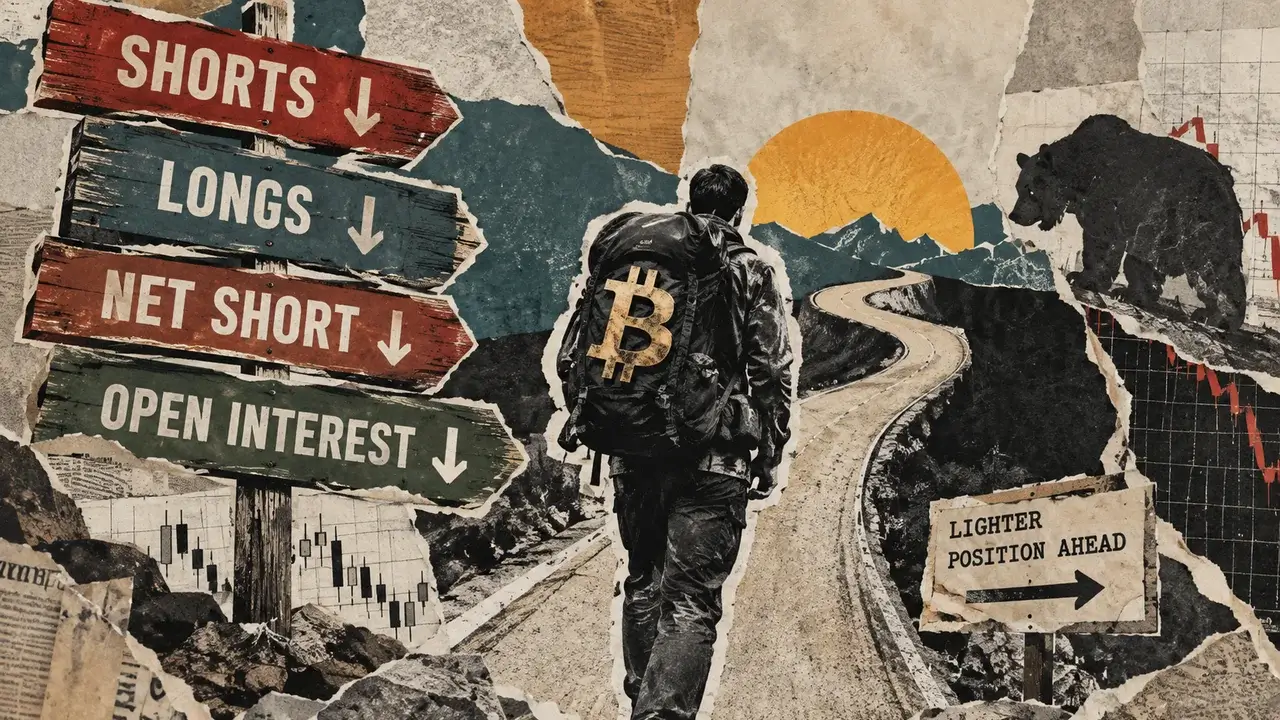
Leveraged funds’ Bitcoin futures shorts fall by 5,300 BTC-equivalent as longs shrink
The September 29 snapshot shows leveraged funds’ reported shorts fell about 5,300 BTC-equivalent across four p...
🚀 RocketCoin Casino
Online Casinos Australia 2026 New: BitStarz Launched Real Money Online Casino With Instant Withdrawals For Australia Player.
Breaking coverage reported by Crypto Reporter: Online Casinos Australia 2026 New: BitStarz Launched Real Money...
follow-these-steps-to-create-and-sell-custom-products-effortlessly-graphic-design-money-money-poster-design-passive-income-graphic-design
$3000/month on Etsy? Without inventory? Yes. Secret: Printify + Etsy 1. Printify pe AI se design banao 2. Etsy...