CFTC makes its biggest move yet to bring offshore crypto trading back to the US
Story summary
The Commodity Futures Trading Commission (CFTC) is offering US crypto exchanges a federal route to retail leverage as Congress remains stalled on market-structure legislation. On Oct. 5, the financial regulatory agency opened rulemaking for Regulation Crypto Asset Transactions (CTX) and Regulation C
📌 Key Highlights & Takeaways
- The Commodity Futures Trading Commission (CFTC) is offering US crypto exchanges a federal route to retail leverage as Congress remains stalled on market-structure legislation.
- 5, the financial regulatory agency opened rulemaking for Regulation Crypto Asset Transactions (CTX) and Regulation C
The Commodity Futures Trading Commission (CFTC) is offering US crypto exchanges a federal route to retail leverage as Congress remains stalled on market-structure legislation.
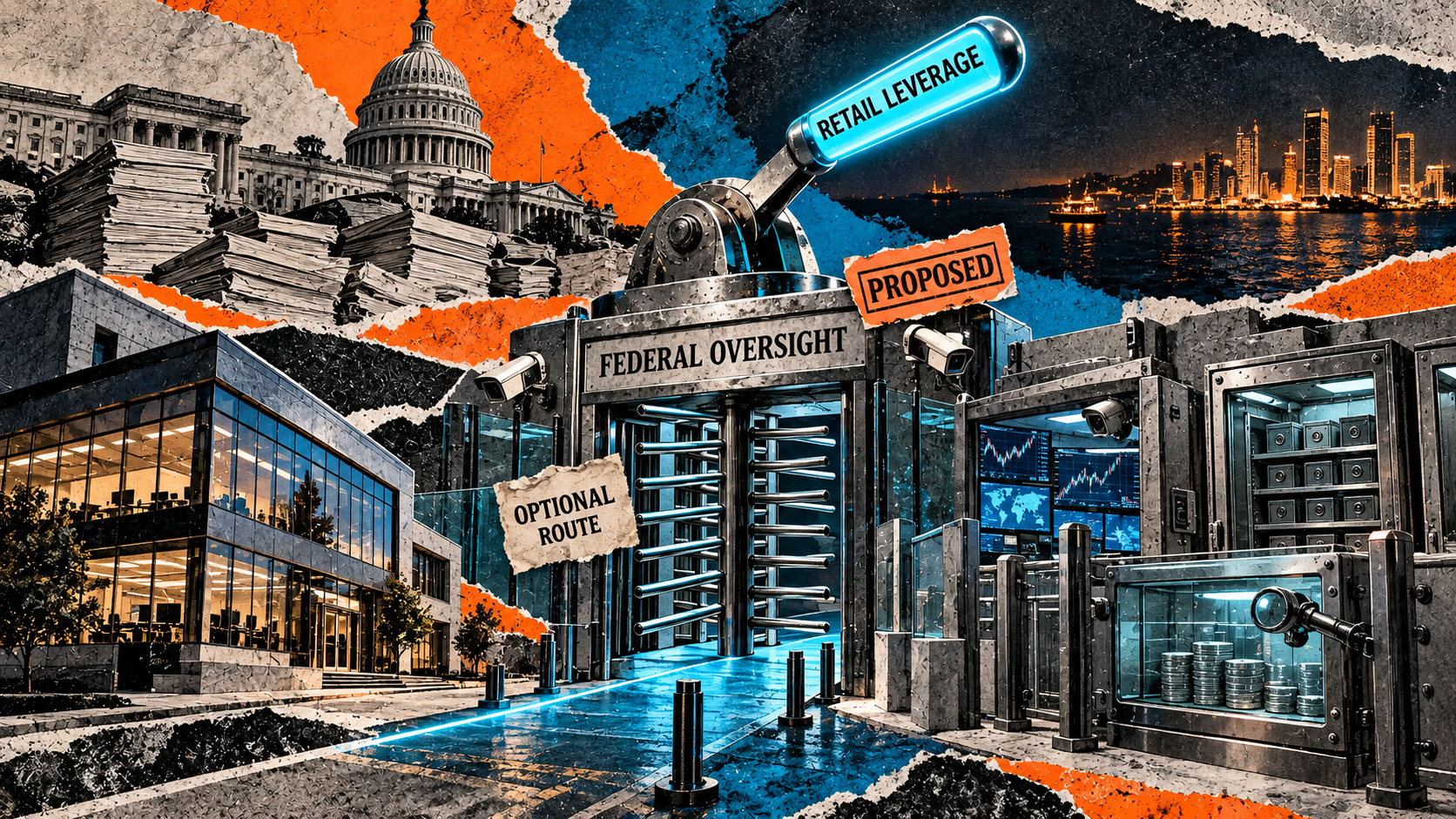
On Oct. 5, the financial regulatory agency opened rulemaking for Regulation Crypto Asset Transactions (CTX) and Regulation Crypto Asset Markets (CAM), which would create a national framework for platforms offering retail customers margined, leveraged, or financed crypto trading.
Participation would remain optional for ordinary spot exchanges because the agency acknowledges it cannot compel the broader crypto market onto CFTC-regulated venues without congressional action. The incentive is access to leveraged products that state money-transmitter licensing alone does not provide.
The initiative gives the CFTC a way to use authority it says already exists under the Commodity Exchange Act while Congress has yet to enact comprehensive legislation governing crypto spot markets.
The framework would effectively create three regulatory paths depending on what an exchange wants to offer US customers.
Ordinary spot exchanges could remain primarily under state licensing regimes, supplemented by the CFTC’s existing anti-fraud and anti-manipulation authority.
Platforms offering leveraged or financed retail crypto transactions could seek federal registration under the new framework, while venues offering futures, perpetuals and other derivatives would remain under the agency’s existing designated contract market regime.
CAM would sit in that middle category.
From an on-chain analytics and liquidity distribution perspective, developments around "CFTC makes its biggest move yet to bring offshore crypto trading back to the US" signal important shifts in network participation. Market participants observe that derivative funding metrics, exchange reserve telemetry, and smart contract protocol interactions reflect cautious accumulation alongside disciplined risk hedging across the sector.
Technical research analysts at 1UpTrade Live note that high-density order book clusters and volume-weighted average price (VWAP) benchmarks near recent consolidation floors will serve as pivotal indicators. Market observers are advised to cross-examine telemetry on verified block explorers before making capital allocations.
Editorial Fact-Check & Verification Note: This briefing was curated, corroborated, and synthesized by the 1UpTrade Live Editorial Desk. Readers following "CFTC makes its biggest move yet to bring offshore crypto trading back to the US" are encouraged to review the full primary source coverage linked below for complete historical context, direct quotes, and official statements.
Crypto Profit & Yield Calculator
Simulate trading returns, staking APY, and crypto gains with real-time fee modeling.
Source: CryptoSlate.
Read the full story at the original source ↗
For questions: mrsmithcons@gmail.com.
❓ Frequently Asked Questions (Crypto Scalping Briefing)
What on-chain catalyst or market signal triggered this Crypto Scalping movement?
Institutional on-chain telemetry, cold storage accumulation, and derivative funding rates indicate spot liquidity positioning that underpins this Crypto Scalping development.
How should investors interpret current liquidity pools and network hash activity?
Derivative funding remains balanced and exchange reserves continue trending downward, mitigating systemic liquidation cascades and strengthening the underlying structural floor.
Where are the critical technical support and invalidation levels?
Anchored volume-weighted average price (VWAP) benchmarks and high-density order book clusters near prior consolidation ranges serve as key risk management thresholds.
📈 Live Scalping Metrics & Prop Firm Risk Model
Institutional order flow data, risk-reward ratios, and prop challenge models.
⚡ Access Trading Terminal ➔More from 1UpTrade Live


 🎁 Get Rich Free
Crypto Airdrops Explained: History, Biggest Payouts and the 5 Best Sites to Track Them
Breaking coverage reported by Trade Brains: Crypto Airdrops Explained: History, Biggest Payouts and the 5 Best...
 🤖 1UpTrade Quant
Crypto Trading API Guide: The Best APIs For Automated Trading In 2026
Breaking coverage reported by Bitcoin Foundation: Crypto Trading API Guide: The Best APIs For Automated Tradin...
 🐋 CryptoAce VIP
ZachXBT infiltrates $1B crypto syndicate to expose Lazarus Group
His October 5 disclosure describes 2025 trades and private chats that he says helped trace Bybit funds and sec...
🚀 RocketCoin Casino
Crypto Casino Research 2026
Breaking coverage: Crypto Casino Research 2026. Comprehensive monitoring, ongoing statements, and verified rep...