Plunging GPU prices threaten AI hosts, and new hedges step in
Story summary
Companies building AI applications can rent powerful computers instead of buying the equipment themselves, paying for access to the graphics processing units, or GPUs, that run their software. Lower rental prices make those applications cheaper to operate, but they can also make life harder for the
📌 Key Highlights & Takeaways
- Companies building AI applications can rent powerful computers instead of buying the equipment themselves, paying for access to the graphics processing units, or GPUs, that run their software.
- Lower rental prices make those applications cheaper to operate, but they can also make life harder for the
Companies building AI applications can rent powerful computers instead of buying the equipment themselves, paying for access to the graphics processing units, or GPUs, that run their software.
Lower rental prices make those applications cheaper to operate, but they can also make life harder for the company that bought the machines and needs the rent to pay its debts.
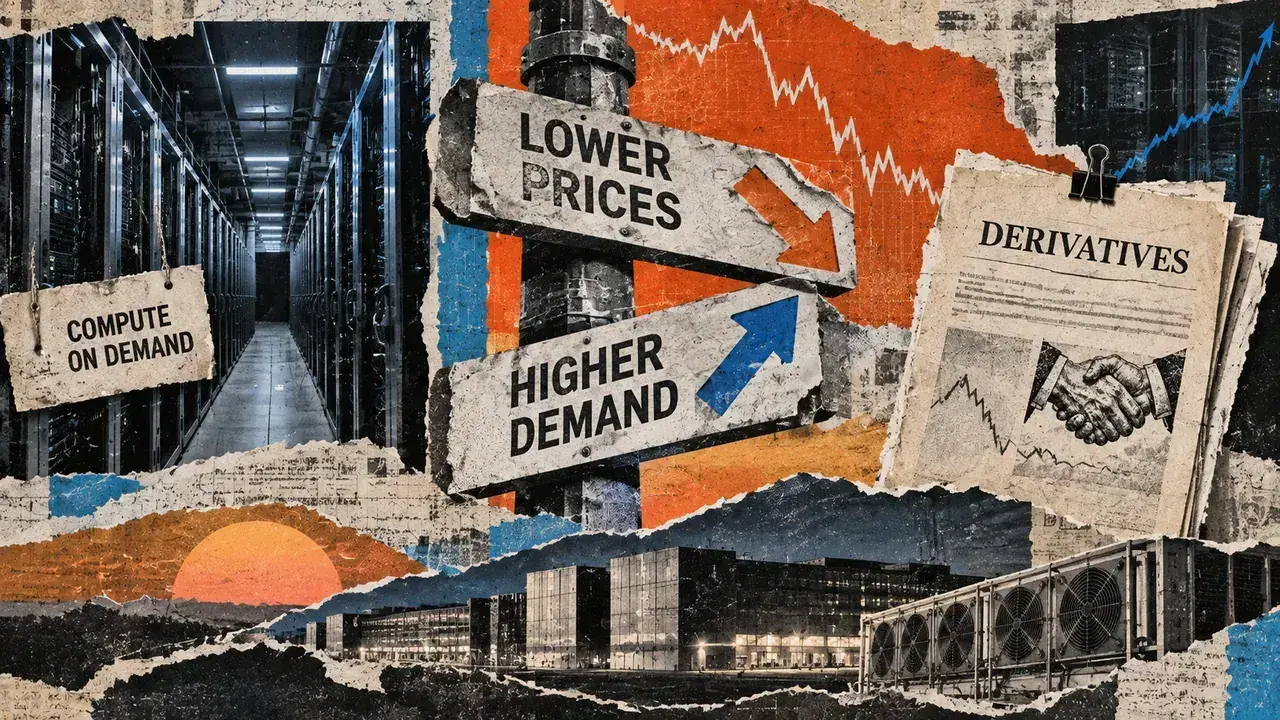
If you've financed a room full of GPUs assuming customers will pay a certain hourly rate, a cheaper competitor can upset the calculation long before you've paid off the equipment. Your machines might still work perfectly, and demand for AI might still be strong, but the amount you earn from each hour could start falling below what the business needs.
Financial contracts could let you protect part of that income by arranging a payment when rental prices fall, in exchange for taking on your own obligations. That's the basic idea behind AI compute derivatives, which let businesses trade their exposure to computing prices separately from renting the computers themselves.
Luxor , a company that provides services and financial products to Bitcoin miners , included these contracts in its latest expansion into AI . It sees an opportunity to bring its experience hedging mining revenue to another business that spends heavily on machines before knowing what it'll earn.
The company told CryptoSlate that it's already brokering agreements between owners of computing capacity and customers who want to use it.
However, its cash-settled derivatives business is still early, and the company said it couldn't provide a customer hedge example or current derivatives trading volumes because a liquid market hadn't formed yet.
That gives this promising idea the difficult commercial task of persuading someone to accept losses another business wants to avoid.
From an on-chain analytics and liquidity distribution perspective, developments around "Plunging GPU prices threaten AI hosts, and new hedges step in" signal important shifts in network participation. Market participants observe that derivative funding metrics, exchange reserve telemetry, and smart contract protocol interactions reflect cautious accumulation alongside disciplined risk hedging across the sector.
Technical research analysts at 1UpTrade Live note that high-density order book clusters and volume-weighted average price (VWAP) benchmarks near recent consolidation floors will serve as pivotal indicators. Market observers are advised to cross-examine telemetry on verified block explorers before making capital allocations.
Editorial Fact-Check & Verification Note: This briefing was curated, corroborated, and synthesized by the 1UpTrade Live Editorial Desk. Readers following "Plunging GPU prices threaten AI hosts, and new hedges step in" are encouraged to review the full primary source coverage linked below for complete historical context, direct quotes, and official statements.
Crypto Profit & Yield Calculator
Simulate trading returns, staking APY, and crypto gains with real-time fee modeling.
Source: CryptoSlate.
Read the full story at the original source ↗
For questions: mrsmithcons@gmail.com.
❓ Frequently Asked Questions (Day Trading Hacks Briefing)
What on-chain catalyst or market signal triggered this Day Trading Hacks movement?
Institutional on-chain telemetry, cold storage accumulation, and derivative funding rates indicate spot liquidity positioning that underpins this Day Trading Hacks development.
How should investors interpret current liquidity pools and network hash activity?
Derivative funding remains balanced and exchange reserves continue trending downward, mitigating systemic liquidation cascades and strengthening the underlying structural floor.
Where are the critical technical support and invalidation levels?
Anchored volume-weighted average price (VWAP) benchmarks and high-density order book clusters near prior consolidation ranges serve as key risk management thresholds.
📈 Live Scalping Metrics & Prop Firm Risk Model
Institutional order flow data, risk-reward ratios, and prop challenge models.
⚡ Access Trading Terminal ➔More from 1UpTrade Live


 🐋 CryptoAce VIP
New SEC crypto rules threaten small advisers, but big firms win
The SEC’s modeled $433,833 annual adviser cost subtotal excludes significant technology spending, raising ques...
follow-these-steps-to-create-and-sell-custom-products-effortlessly-graphic-design-money-money-poster-design-passive-income-graphic-design
$3000/month on Etsy? Without inventory? Yes. Secret: Printify + Etsy 1. Printify pe AI se design banao 2. Etsy...
 💵 GetRichFree Store
Chase $900 Checking + Savings Bonus
Targeted: Chase is offering a checking & savings bonus: $300 checking bonus, $200 savings bonus. Additional $4...
🤖 1UpTrade Quant
Fibonacci Structure Engine [WillyAlgoTrader] — Indicator by WillyAlgoTrader
Breaking coverage reported by tradingview.com: Fibonacci Structure Engine [WillyAlgoTrader] — Indicator by Wil...